Beyond Human Eyes: How Dr. Shruti Patil Uses AI to Pick Your Best Embryo First.
When Anjali and her husband saw the tiny embryo on the screen, they didn’t know it, but a computer had already judged its potential. In modern IVF, embryologists aren’t alone under the microscope — they have artificial intelligence (AI) as a secret assistant. Dr. Shruti Patil’s clinic is embracing this high-tech helper. By analyzing thousands of past cases and embryo images, AI can spot subtle patterns that even experienced doctors might miss, helping pick the embryo with the highest chance of pregnancy.
In the past, embryologists graded embryos by eye: number of cells, symmetry, and growth over a few days. This human process is good, but somewhat subjective and limited. Now imagine an AI that has “seen” millions of embryos and their outcomes. It uses deep learning algorithms to assess morphology, timing, and even pixel-level features from time-lapse videos. In practical terms, AI serves as a second expert opinion, saying “this one” to the embryo most likely to become a baby. Early reports from top clinics (like Reproductive Science Center in California) show that integration of AI has raised their IVF success rates significantly, sometimes to around 68%.
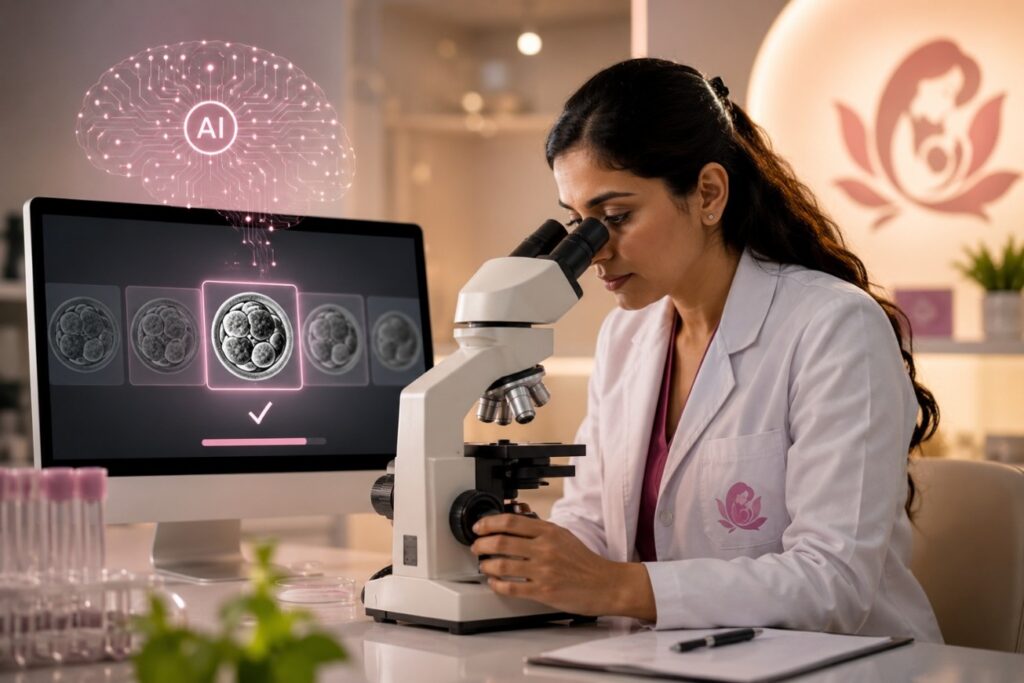
Figure: AI in the IVF lab. Embryos are imaged continuously in an incubator, and advanced algorithms analyze these images to predict which embryo has the best chance of implanting and growing. This adds powerful data to the embryologist’s expertise.
AI Meets the Embryo
So how does this work without taking over the doctor’s job? Let’s step through it. First, our lab takes high-resolution time-lapse videos of each embryo as it develops in the incubator. The AI software — trained on vast libraries of past cases — compares features like cell division times, shape changes, and even tiny textural details. It then scores each embryo on its viability. For example, an embryo that split evenly and had certain glowing patterns on the time-lapse might get a high AI score. The embryologist still looks at the embryos, but with the AI’s recommendation in hand.
“We don’t let the AI make decisions in isolation,” explains Dr. Patil. “It’s a tool to enhance, not replace, our judgment.” This approach echoes a leading U.S. clinic’s experience: they combined AI with patient data (age, medical history) and the embryologist’s notes to achieve better outcomes. In their words, “Good doctors use medical science and technology together,” blending precision data with personal care.
The science is promising. A recent Scientific Reports study (2025) developed a deep-learning model on over 1,500 embryo videos. The AI could predict implantation success better than chance (an AUC of 0.64). In plain terms, with AI insight a clinic could reduce the number of transfers needed and avoid using embryos unlikely to implant. While AUC=0.64 is not perfect, it’s a significant boost when combined with human review. The authors noted the AI “could be an adjunct tool for biologists to better select embryos and reduce useless transfers”.
Imagining the First-Embryo Decision
Let’s imagine an IVF day. Dr. Patil and her team culture a cohort of, say, 4–6 embryos. On Day 5, three look similar to the human eye. The AI system analyzes their growth videos overnight. Morning arrives, and the AI report shows Embryo #2 has a 70% predicted success score, higher than Embryo #1 (60%) and Embryo #3 (30%). Dr. Patil considers this alongside other factors (genetic screening results, patient’s age, any previous IVF history). Together, they decide to transfer Embryo #2 first.
This data-driven approach can be a game-changer. One US fertility center reported that after adopting AI-based selection, their patients’ overall success rate climbed to ~68%. Another patient whose friend had failed IVFs found hope: her clinic’s AI flagged a seemingly “ordinary” embryo as top-quality, and it implanted on the first try. As one patient said, “It feels like you’re getting the best possible guess, not blind luck.”
Figure: The algorithm at work. Deep-learning models analyze embryo development videos in real time, looking for the smallest morphological cues to predict which embryo is most viable. This continuous monitoring provides far more data than traditional spot-check observations.
Why AI Helps, Not Hurts
You might wonder, isn’t this just high-tech hype? AI in medicine can sound futuristic, but it already handles millions of dollars in diagnostics (like tumor scans). In IVF, where each embryo transfer matters, a little extra information is hugely valuable. Studies comparing AI vs. humans found AI often outperforms embryologists in predicting implantation. For example, a review found AI consistently did better at analyzing embryo images and predicting success rates. Importantly, AI does the tedious work of scanning every frame and feature, leaving doctors to focus on big-picture care.
However, AI isn’t a magic box. We still need clinician oversight. The models are only as good as the data they train on — which is why Dr. Patil’s clinic uses global data and continually updates the AI. They also explain that AI doesn’t replace human touch: patients still have counseling, and doctors make the final call, not a computer. This balance is crucial for trust.
What It Means for You
For hopeful parents, this means less guesswork and potentially fewer IVF cycles. Instead of trying embryos one by one, an AI-enhanced clinic can give you a shortlist of the most promising ones. It also means staying on the cutting edge of fertility tech. Dr. Patil’s team reads the latest papers and attends conferences on AI in IVF, to ensure they offer the best options.
If you’re considering IVF with Dr. Patil, know that her clinic integrates AI by default. During your consultation, you’ll have the opportunity to ask about it. You might also see the digital report on screen after fertilization: the embryos categorized and scored, which can be both hopeful and a bit overwhelming to see data translating into “odds.” Dr. Patil suggests viewing it as an extra safety net, not a guarantee.
It’s also worth noting that regulatory bodies are keeping an eye on AI in healthcare. So far, tools like these are used adjunctively, meaning they’re allowed as long as human doctors supervise. This helps ensure safety and personal choice.
Tips and Takeaways
What can patients do now? While you can’t bring AI home, you can:
- Ask Your Clinic: Inquire if they use any AI or time-lapse systems. Clinics using newer labs often do.
- Stay Informed: AI is advancing. What’s cutting-edge today might be standard in a few years. Choose clinics that invest in technology.
- Balance Expectations: AI improves odds, but success isn’t 100%. It complements, not replaces, good embryology practice.
- Maintain a Healthy Lifestyle: Because underlying egg quality still matters. The best embryo from eggs affected by age or health may still face challenges. So follow Dr. Patil’s advice on nutrition and supplements even as you leverage AI.
By blending artificial intelligence with skilled care, we aim to pick “the best in class” embryo on the first try. It’s like tuning a radio to the clearest station — you want that perfect signal (pregnancy) with minimal noise (failed cycles).
“Our goal is to give patients the highest chance to succeed the first time,” Dr. Patil explains. “AI is another tool that helps us do that, so you spend less time waiting and more time holding your baby.”
Contact Us Today
Name: Dr Shruti Rothe Patil
Address: Shop No 205 second floor, Gaikwad Villa, Seasons Rd, opposite Punjab National Bank, Sahil Park, Sanewadi, Aundh, Pune, Maharashtra 411007
Phone: 77985 97722
Website:
Chronic inflammation from a poor diet doesn’t stay in the ovaries. It travels. It settles in the hips, the knees, and the shoulders. If you are struggling with General Physical Therapy issues or recovering from Fractures / Trauma / Accident, your body needs the building blocks of repair.
When inflammation is left unchecked, it can lead to structural decay. We see patients who, after years of systemic inflammation and “fat-free” dieting, face conditions like Avascular Necrosis (AVN) or require a Total Hip Replacement Surgery.
By incorporating anti-inflammatory fats like A2 Ghee, you are performing “preventative maintenance” on your joints. You are reducing the likelihood that you will one day need a Minimally Invasive Subvastus Knee Replacement Surgery or Robotic Knee Replacement Surgery. Whether it’s managing a Ratator cuff tear or preventing a Recurrant shoulder dislocation, the “Language” of healing begins with the fats you eat.
Multimedia: How to Use Ghee for Healing
The Daily Routine:
The Morning Spoon: Start your day with one teaspoon of warm A2 Ghee on an empty stomach to “ignite” your digestive fire (Agni).
The Cooking Swap: Replace vegetable oils with Ghee for sautéing. Its high smoke point makes it safer and more Unique than olive oil for Indian cooking.
The Nightcap: A drop of Ghee in warm milk (A2) before bed can help regulate the nervous system and support those dealing with menopausal insomnia.
Reclaiming Your Health at Dr. Shruti Rothe Patil’s Clinic
Whether you are seeking a Normal Delivery Specialist to help you navigate a healthy pregnancy or need a Highrisk Pregnancy Specialist who understands the nutritional nuances of 2026, we are here to provide Answers.
Our dual-specialty approach ensures that if your hormonal imbalance has led to physical strain, our orthopedic experts are ready to assist—from Shoulder Arthroscopy to complex Revision Knee Replacement or Revision Hip Replacement. We even provide specialized Post-Op Physical Therapy to get you back on your feet.
Don’t let modern myths dictate your biological future. Reclaim the traditional fats that your body has craved for generations.
Visit Us in Aundh
Name: Dr Shruti Rothe Patil
Address: Shop No 205, Second Floor, Gaikwad Villa, Seasons Rd, Opposite Punjab National Bank, Sahil Park, Sanewadi, Aundh, Pune, Maharashtra 411007
Phone: 77985 97722
Website: drshrutipatil.in
Recent Posts
-
 niPGT Demystified: The Non-Invasive Future of Genetic Testing Without Touching the Embryo
 -
 Beyond Human Eyes: How Dr. Shruti Patil Uses AI to Pick Your Best Embryo First.
 -
 “Skinny PCOS”: The Hidden Metabolic Crisis in Pune’s Lean Professional Women
 -
 The Gut–Ovary Axis: Why Your PCOS Treatment Should Actually Start in Your Stomach
 -
 A2 Ghee and Anti-Inflammation: Reclaiming Traditional Fats for Hormonal Healing