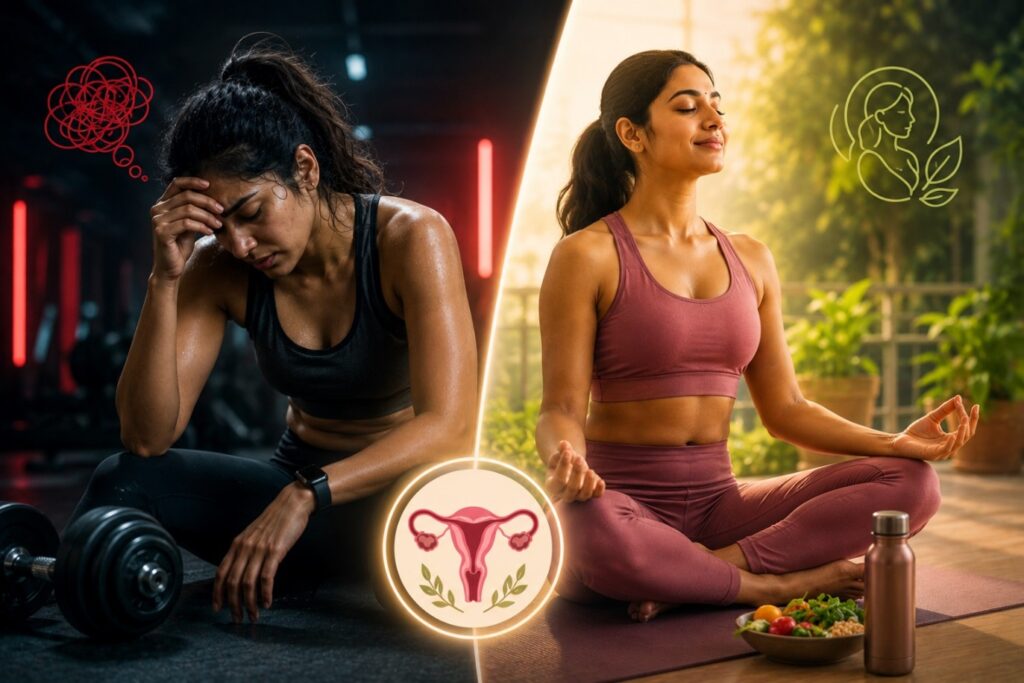
Hormone-Happy Movement: Why Your Punishing Gym Workout Might Be Making Your PCOS Worse
You have been told for years that the only way to “fix” your PCOS is to lose weight, and the only way to lose weight is to grind through punishing, hour-long HIIT sessions until you’re gasping for air. But what if the very thing you’re doing to improve your health is actually making your hormones more imbalanced?
In the high-energy fitness hubs of Aundh and Baner, it’s common to see women pushing themselves to the absolute limit. We are a city of achievers, after all. But at Dr. Shruti Rothe Patil’s Clinic, we see a different side of this hustle. We meet women who are doing “everything right”—the 5 AM workouts, the calorie counting, the heavy lifting—yet their periods are still irregular, their acne continues to flare, and the weight around their midsection refuses to budge.
This isn’t a lack of willpower. It’s a biological mismatch.
The Story of the “Perfect” Athlete
Let’s talk about “Priya.” Priya is a 28-year-old software professional living in Aundh. Like many women, she was diagnosed with PCOS in her early 20s. To manage it, she joined a high-intensity bootcamp and trained six days a week, believing that the harder she exercised, the faster her hormones would improve.
Three months later, Priya felt worse than ever. Her hair had started thinning, her anxiety had increased, and she constantly felt bloated and exhausted. During her consultation, her blood tests revealed elevated cortisol—the body’s primary stress hormone. High cortisol was disrupting her hormonal balance and affecting progesterone levels, making her PCOS symptoms even more challenging.
Priya didn’t need more punishment. She needed Hormone-Happy Movement.
The Science: Why “More” is Sometimes “Less”
Research published in the International Journal of Pharmaceutical and Clinical Research highlights that regular physical activity is one of the most effective lifestyle interventions for PCOS. However, the type, intensity, and consistency of exercise matter just as much as the exercise itself.
Very intense workouts performed frequently without proper recovery can significantly increase cortisol levels. Since many women with PCOS already experience insulin resistance and hormonal imbalance, prolonged stress can worsen these underlying issues.
High cortisol may:
- Increase blood sugar levels
- Trigger higher insulin production
- Stimulate excess androgen (testosterone) production
- Worsen acne, unwanted hair growth, irregular periods, and weight gain
This is why exercising smarter—not simply harder—is often the better strategy for managing PCOS.
The PCOS Wellness Framework
Instead of focusing only on calories burned, build your fitness routine around these principles:
Quality Over Quantity
A well-planned 30-minute strength training session can be more beneficial than an hour of exhausting cardio.
Listen to Your Body
Persistent fatigue, brain fog, poor sleep, or prolonged muscle soreness are signs your body may need recovery.
Stay Consistent
Gentle daily movement like walking, yoga, Pilates, or resistance training delivers better long-term hormonal benefits than extreme workout routines.
Exercise According to Your Cycle
During the week before your period, your body may benefit more from restorative movement than intense training.
Prioritize Recovery
Sleep, balanced nutrition, hydration, and stress management are just as important as exercise itself.
Personalize Your Routine
Every woman’s PCOS is different. The best workout plan is the one designed around your symptoms, hormones, and lifestyle.
How to Transition to “Hormone-Happy” Movement
If you’re ready to stop punishing your body and start supporting your hormones, consider these habits:
Prioritize Strength Training
Building lean muscle improves insulin sensitivity and supports healthy metabolism without excessive cortisol spikes.
Walk Every Day
A simple 20–30 minute walk, especially after meals, helps regulate blood sugar and improve insulin response.
Include Low-Impact Exercise
Yoga, Pilates, stretching, swimming, and mobility exercises help reduce stress while supporting hormonal health.
Focus on Recovery
Rest days are essential. Your hormones recover when your body does.
Nourish Your Body
Exercise works best when paired with adequate protein, fiber, healthy fats, and nutrient-rich whole foods.
Expert PCOS Care for Every Stage of Life
Managing PCOS isn’t about pushing yourself harder—it’s about understanding your body and giving it what it truly needs.
At Dr. Shruti Rothe Patil’s Clinic, we provide personalized care for women dealing with:
- PCOS and hormonal imbalance
- Irregular periods
- Fertility concerns
- Pregnancy planning
- High-risk pregnancy management
- Women’s preventive healthcare
Our goal is to help you achieve long-term hormonal wellness through evidence-based treatment, lifestyle guidance, and compassionate care.
Stop Punishing Your Body. Start Healing It.
Your body isn’t working against you—it simply needs the right support.
Small, sustainable lifestyle changes often produce better hormonal outcomes than extreme diets and exhausting workout routines.
If you’re struggling with PCOS symptoms despite doing “everything right,” it may be time for a personalized treatment plan.
Contact Us Today
Dr. Shruti Rothe Patil
Address:
Shop No. 205, Second Floor, Gaikwad Villa, Seasons Road, Opposite Punjab National Bank, Sahil Park, Sanewadi, Aundh, Pune – 411007
Phone: 77985 97722
Website: drshrutipatil.in
Our Women’s Healthcare Services
- PCOS & Hormonal Disorder Management
- Infertility Evaluation & Treatment
- Pregnancy Planning
- High-Risk Pregnancy Care
- Antenatal & Postnatal Care
- Menstrual Disorder Treatment
- Adolescent Gynecology
- Menopause Management
- Routine Gynecological Check-ups
Your journey toward balanced hormones and better health starts with one mindful step
Recent Posts
-
 niPGT Demystified: The Non-Invasive Future of Genetic Testing Without Touching the Embryo
 -
 Beyond Human Eyes: How Dr. Shruti Patil Uses AI to Pick Your Best Embryo First.
 -
 “Skinny PCOS”: The Hidden Metabolic Crisis in Pune’s Lean Professional Women
 -
 The Gut–Ovary Axis: Why Your PCOS Treatment Should Actually Start in Your Stomach
 -
 A2 Ghee and Anti-Inflammation: Reclaiming Traditional Fats for Hormonal Healing